The individual hearing
This is the trial. You testify under oath, a government attorney cross-examines you, your witnesses are heard, and the immigration judge decides. In most cases it is the only day anyone hears your account in person, and in a non-detained case it is usually years in the making. After it, the record is close to final.
Current as of September 2026. We re-check this page every quarter and after any rule change.
Everything before this was preparation. The pleadings, the applications filed in the alternative, the exhibits gathered over months, the declarations, the witnesses lined up: all of it exists to support what happens in this room. Where the hearing sits in the whole case is on how removal proceedings work.
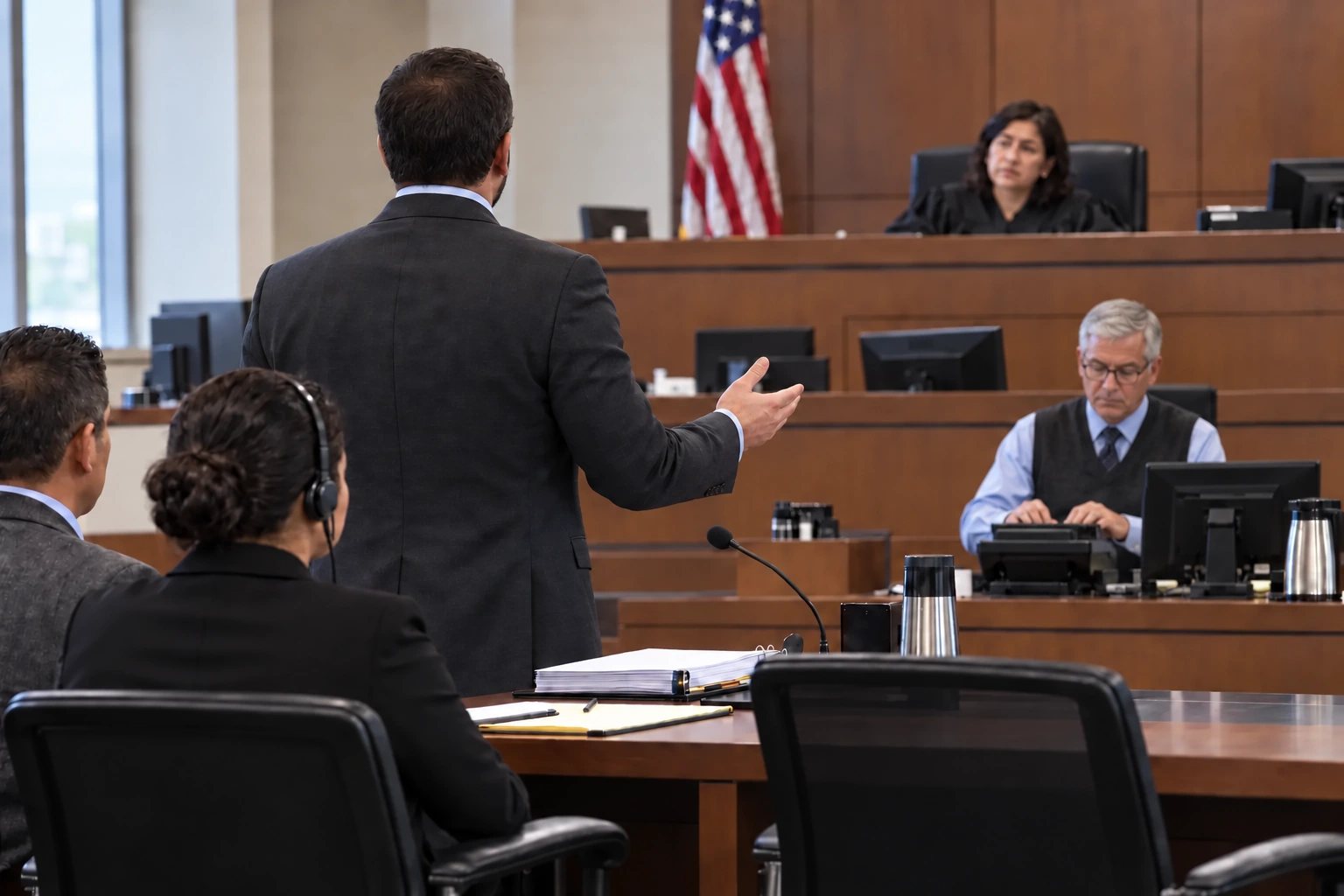
How the day runs
- Preliminaries. The judge takes appearances, confirms which applications are before the court, marks the exhibits, and hears any outstanding objections and motions.
- Removability, if contested. Where you denied the allegations or charges, DHS puts in its proof and you respond. See contesting removability.
- Opening statement. If the judge permits one. Many want it short or not at all.
- Your direct testimony. You answer questions from your own lawyer, or from the judge if you are unrepresented.
- Cross-examination. The DHS attorney questions you.
- Questions from the judge. The judge may question you and every witness at any point. This is not a courtroom where the bench stays silent.
- Redirect. Your lawyer may follow up.
- Your witnesses. Each goes through direct, cross and judicial questioning.
- Closing argument. Both sides sum up.
- Decision. Often oral, from the bench, at the end.
Every witness, including you, is placed under oath before testifying, and the court provides an interpreter for the hearing.
Witnesses
A witness is useful when they saw something themselves. A spouse who can describe a child's medical condition day to day, an employer who can describe ten years of attendance, a person who was in the room when an arrest happened. A witness who repeats what you told them adds little and can hurt if the versions differ. Expert witnesses, such as a treating physician, a psychologist, or a country-conditions expert, testify to what is inside their expertise and are cross-examined on it. Every witness has to be listed and their statement filed by the deadline below, and the judge can limit testimony that duplicates a filed declaration.
The burden, precisely
- On the charge, if you were admitted, DHS proves deportability by clear and convincing evidence under INA 240(c)(3)(A) and 8 C.F.R. 1240.8(a). If you are charged as an applicant for admission, the burden is yours under INA 240(c)(2) once DHS establishes alienage.
- On every application for relief, the burden is yours. Under 8 C.F.R. 1240.8(d), you must establish eligibility "and that it should be granted in the exercise of discretion," and where the evidence indicates that a mandatory ground of denial may apply, you must show by a preponderance that it does not.
- On a criminal conviction, under Pereida v. Wilkinson, 592 U.S. 224 (2021), an applicant for relief loses if the record is inconclusive on whether the conviction disqualifies them. Get the certified record of conviction before the hearing, not after.
Exhibits and the 30-day deadline
Everything is due at least 30 days before the hearing
In non-detained cases, the Immigration Court Practice Manual, chapter 2.1, requires filings at least 30 days before the individual hearing, with responses due within 10 days. In detained cases the deadline is whatever the judge specifies. Deadlines are counted in calendar days, and the court applies a receipt rule: a document is filed when the court has it. Attorneys and accredited representatives must file through ECAS under 8 C.F.R. 1003.31. A late exhibit may be excluded, and a late application may be deemed abandoned. The full list is on the deadlines page.
The exhibit package for a typical hearing includes the application itself and any amendments, your declaration, identity and status documents, certified conviction records, evidence for each element of each form of relief, hardship evidence for any qualifying relative, country-conditions evidence where relevant, witness lists and statements, and translations with certificates for every foreign-language document. Evidence that arrives after the deadline generally does not come in, and the government will object if it does.
Preparing to testify
Your job on the stand is not to be moving. It is to be specific, consistent and responsive. The judge weighs demeanor, candor, plausibility, and consistency between what you wrote and what you say.
- Reread everything you have signed in this case and in any prior immigration matter: applications, declarations, any statement to an officer. You will be cross-examined from them.
- Fix errors before the hearing, in writing. An amendment filed 30 days out is housekeeping. A correction extracted on cross is a credibility finding.
- Know your chronology cold, and know which dates you are genuinely unsure of, so that you can say so instead of guessing.
- Answer the question asked, then stop.
- Say "I do not remember" when it is true. It is a complete answer.
- Correct interpretation errors immediately, on the record.
- Prepare the discretionary case. Under 8 C.F.R. 1240.8(d) it is your burden, and most applicants bring nothing to it.
Preserving issues
The individual hearing is where the appellate record is made. Under 8 C.F.R. 1003.1(d)(3), the Board reviews the judge's findings of fact, including credibility, only for clear error, and reviews questions of law, discretion and judgment de novo. Facts not put in the record are not facts on appeal. Objections not made on the record are hard to raise later.
- Object, on the record, to any evidence you contest, and state the ground.
- Ask for a ruling on every motion, and note it if the judge does not give one.
- Make an offer of proof when the judge excludes evidence or cuts off testimony.
- Put every legal argument in a written brief filed by the deadline, so that it is in the record whether or not the judge addresses it.
Two rules protect you if the judge gets something wrong. Under Santos-Zacaria v. Garland, 598 U.S. 411 (2023), exhaustion under INA 242(d)(1) is not jurisdictional, and you do not have to file a motion to reconsider to exhaust an error the Board itself made. And the sentence in the 2026 interim rule that deemed any issue not listed in the Notice of Appeal waived was vacated in Amica Ctr. for Immigrant Rights v. EOIR, No. 1:26-cv-00696 (D.D.C. Mar. 8, 2026). The pre-existing rule survives, though: under 8 C.F.R. 1003.1(d)(2)(i), an appeal that fails to specify its reasons can still be summarily dismissed. Say what was wrong, and say it specifically.
The decision, and what follows
Judges often decide orally at the end of the hearing, reading the decision into the record. Sometimes the decision is reserved and comes in writing. Either party may appeal. If the judge grants relief, DHS may reserve its appeal, and the grant is not final until the appeal period has run or the appeal is decided.
The appeal to the Board is due in 30 calendar days
Under 8 C.F.R. 1003.38(b), the Notice of Appeal on Form EOIR-26 is due within 30 calendar days of the oral decision, or of the mailing or electronic notification of a written one, and under 8 C.F.R. 1003.38(c) the Board applies a receipt rule. The 10-day deadline published in early 2026 was vacated before it took effect and the eCFR still prints it; the BIA appeal page explains why. Under 8 C.F.R. 1003.6(a), a timely appeal generally stays execution of the decision while it is pending. A government filing fee applies to the appeal, or a fee waiver request on Form EOIR-26A must accompany it, or under 8 C.F.R. 1003.38(d) the appeal is not properly filed.
Why the record is close to final
On March 4, 2026, in Urias-Orellana v. Bondi, No. 24-777, the Supreme Court held that the courts of appeals review the agency's persecution determination under the substantial-evidence standard of 8 U.S.C. 1252(b)(4)(B), reversing only if the record compels a contrary result. Under Patel v. Garland, 596 U.S. 328 (2022), the factual findings underlying a denial of discretionary relief are not reviewable at all. What remains reviewable is narrower: constitutional claims and questions of law under INA 242(a)(2)(D), which under Guerrero-Lasprilla v. Barr, 589 U.S. 221 (2020), includes the application of a legal standard to established facts, and, under Wilkinson v. Garland, 601 U.S. 209 (2024), whether established facts meet the hardship standard for cancellation.
Every one of those doctrines starts with the phrase "established facts." The facts are established here, in front of the immigration judge, and nowhere else. A court of appeals will not re-weigh them, and the Board will disturb them only for clear error. That is why the exhibit deadline, the declaration, the witnesses and the objections on this page matter more than anything that happens afterward.
If the application being tried is asylum, withholding or CAT, the testimony, corroboration and credibility rules have their own body of law, and it moved fast in 2025 and 2026. Our asylum site carries it in full.
Defensive asylum at asylumadvocate.com →
asylumadvocate.comHow to build an evidence package for a merits hearing, document by document, with translation and authentication requirements.
The evidence guide at asylumadvocate.com →
Read next: the deadlines, the BIA appeal, the master calendar hearing, or after a removal order.
Common questions
What is an individual hearing?
It is the evidentiary hearing on the contested issues in your case, also called a merits hearing or an individual calendar hearing. Any contested question of removability is tried, and then each application for relief: testimony, cross-examination, witnesses, exhibits, argument and a decision. The master calendar hearings before it were scheduling; this is the trial.
When do I have to file my evidence?
In non-detained cases, the Immigration Court Practice Manual, chapter 2.1, requires filings at least 30 days before the individual hearing, with responses due within 10 days. In detained cases the judge sets the deadline. The court applies a receipt rule, so a document is filed when the court has it, and attorneys must file through ECAS under 8 C.F.R. 1003.31.
Who bears the burden at the individual hearing?
On the charge, if you were admitted, DHS must prove deportability by clear and convincing evidence under INA 240(c)(3)(A). On every application for relief, you do: under 8 C.F.R. 1240.8(d) you must establish eligibility and that relief should be granted in the exercise of discretion, and you must disprove any apparent mandatory-denial ground by a preponderance of the evidence.
Will I get a decision that day, and how long do I have to appeal?
Often the judge decides orally at the end of the hearing. Sometimes the decision is reserved and issued in writing. Either way, an appeal to the Board of Immigration Appeals is due within 30 calendar days under 8 C.F.R. 1003.38(b), counted from the oral decision or the mailing or electronic notification of a written one, and the Board applies a receipt rule. A timely appeal generally stays the decision while it is pending.
Tell us where your case is. We will tell you what is still possible.
You get a free case review with an attorney, in your language. We speak English, Russian, Spanish and Uzbek in-house, and we bring in a live interpreter for anything else. We will tell you what stage you are at, which forms of relief are open to you, what your deadlines are, and whether we can help. If we cannot, we will say so.